

Global Decline in Cigarette Sales
From 2018 to 2023, global cigarette sales volumes declined by 4%, but excluding China, the drop was a sharper 9%. China remains an outlier with stable daily smoking rates, bolstered by growing demand for premium superslim cigarettes, marketed for elegance. However, developed markets saw the steepest sales drops in 2023, with double-digit declines in Australia and the UK. Japan and the US experienced notable reductions of 33% and 26%, respectively, driven by the rising adoption of reduced-risk products like heated tobacco and nicotine pouches. Additional factors contributing to the decline include stricter regulations, rising excise taxes, economic challenges, and growing health awareness, especially among younger generations.
While cigarette sales continue to fall, they still accounted for 82% of global tobacco and nicotine sales in 2023, down from 88% in 2018. In contrast to the volatility of reduced-risk products, cigarette sales maintain a more predictable decline trajectory. Growth in cigarette consumption was observed only in a few emerging economies, such as Bangladesh and India, where the smoking population is expanding.

Expansion of Heated Tobacco
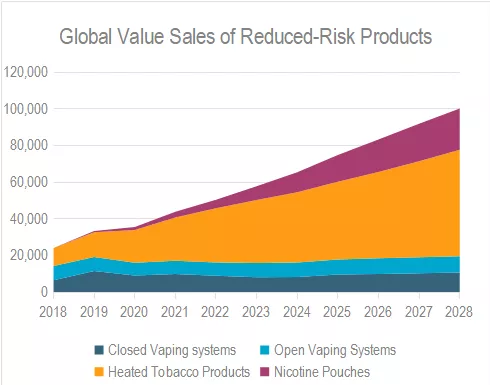
Heated tobacco products comprised 42% of global reduced-risk product sales in 2023, up from 28% in 2018. This growth was fueled by the introduction of more affordable devices, broadening their appeal among adult smokers, particularly in markets like Italy, Japan, and South Korea. The competitive landscape intensified in 2023 and 2024, with new market entries and aggressive pricing strategies. For example, British American Tobacco (BAT) introduced its Hyper X2 devices in South Korea, while Japan Tobacco International (JTI) expanded its Ploom X devices to over 20 global markets. Philip Morris International (PMI) also extended its IQOS Iluma brand to around 50 markets by the end of 2023, including significant new entries like Canada, Malaysia, and Saudi Arabia.
PMI aims to derive over 50% of its revenue from smoke-free products by 2025, with projections of IQOS users increasing from 27 million to 40 million. Similarly, BAT targets a rise in users from 24 million to 50 million by 2030.
Future opportunities for heated tobacco growth lies predominantly in low- and middle-income countries, where smoking rates are highest, although the category is still emerging in these regions. In mature markets, tobacco-free heated sticks introduced by companies like BAT and PMI are expected to sustain the category's growth.
Regulatory Challenges for Single-Use Vaping Devices
Sales of single-use vaping devices surged in 2023, largely due to their affordability and legal loopholes. The rapid growth of disposable vapes has made the category vulnerable to an emerging concern among regulators about youth vaping prevalence. These concerns have led to significant scrutiny from the regulators considering and issuing a complete sales ban in some of the countries, including Australia, Belgium, France and the UK set to come into effect in the upcoming years. These measures are expected to resonate across regions and encourage public health authorities and anti-smoking organisation globally to call for further restrictions on these products. While it is not probable to see complete ban of the product across the world, a more restrictive approach is expected in neighbouring markets, through ban on flavours as an EU initiative. Consequently, major brands such as Elf Bar, Vuse by BAT are already starting to shift focus towards reusable counterparts with replaceable pods and chargeable devices, while keeping the design language of disposable products.
Cautiously sustainable development
To avoid increased scrutiny and stricter regulations that could significantly reduce profitability in this segment and force many small players out of business over the forecast period—potentially boosting sales of illicit products—e-vapour companies are developing new offerings. These products are designed to replicate the strengths of closed-system single-use devices, such as ease of access, convenience, and affordability, while minimizing the use of plastic and toxic materials. Efforts include avoiding bright colors and attractive designs in marketing to prevent associations with underage consumption, designing easy-to-remove batteries, and transforming disposable products into rechargeable vapes to significantly reduce waste generated by single-use systems.
This shift towards reducing environmental impact and limiting the appeal to younger consumers is crucial for ensuring the long-term sustainable growth of closed-system single-use products. Leading players are introducing rechargeable alternatives that mimic disposable vapes, offering new exotic flavors and higher-capacity devices, while others are launching eco-friendly options using recyclable and biodegradable materials, such as AND SLIX from ANDS and QBAR from Riot Squad.
Similar trends are observed across multiple FMCG sectors and are identified as Eco Logical by the data analytics company Euromonitor International in its Top Global Consumer Trends 2025 report. In 2024, over 60% of consumers aimed to positively impact the environment, a steady trend since 2020, with nearly two-thirds concerned about climate change. However, sustainability is now seen as a secondary benefit rather than the main motivator, with consumers prioritizing primary product benefits.
While trust in eco-friendly labels remains strong, affordability is a major barrier. Over half of consumers found green labels trustworthy, but 40% cited high prices as a deterrent. Consumers are more likely to choose sustainable options when they offer similar benefits at competitive prices. To appeal, green attributes must align with the product’s core benefits and address specific consumer needs.

About Euromonitor International
Euromonitor International leads the world in data analytics and research into markets, industries, economies and consumers. We provide truly global insight and data on thousands of products and services to help our clients maximise opportunities, and we are the first destination for organisations seeking growth. With our guidance, our clients can make bold, strategic decisions with confidence. We have 16 offices around the world, with 1000+ analysts covering 210 countries and 99.9% of the world's consumers, and use the latest data science and market research techniques to help our clients to make sense of global markets.
Hungary in focus
The tobacco market in Hungary experienced an overall decline in volume in 2023 due to several factors. Although price increases remained below the inflation rate, the largest market segments, including cigarettes and fine-cut tobacco, saw declining sales. Many consumers shifted to cheaper brands or illicit products as economic pressures strained budgets.
Amid these challenges, heated tobacco products have gained traction, with more smokers switching to these alternatives due to perceived reduced harm and evolving preferences. The growing popularity of heated tobacco devices has positioned Hungary as one of the leading countries in heated tobacco usage. With single-use e-vapour products banned, heated tobacco has benefitted significantly, whereas in most other countries, these categories share the throne in the reduced-risk segment.
The tobacco industry is undergoing significant change as regulations increasingly restrict the sector through measures like plain packaging and higher excise taxes, aiming to bring Hungarian tobacco prices in line with those of Western Europe. At the same time, record-high inflation for essential goods, food, utilities, and fuel in the past 20-25 years has left consumers with less disposable income for tobacco products.
Regulatory pressures have further intensified with the recent ban on flavored heated tobacco products. While manufacturers aim to keep price increases below inflation, higher taxes often push retail prices upward. As regulations tighten and awareness of tobacco-related health risks grows, consumers are increasingly shifting towards alternative and innovative tobacco products.
Cover picture is illustration (Photo: Nejc Soklič / Unsplash)
The article was published in Tobacco 2025/01.
